














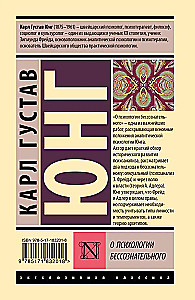

"On the Psychology of the Unconscious" — one of the most important works that reveals the main provisions of Jung's analytical psychology.
The author provides a brief overview of the historical development of psychoanalysis, examines two approaches to the unconscious: the sexual (Freud's psychoanalysis) and through the will to power (Adler's theory). Jung asserts that Freud and Adler are generally right but emphasizes the need to consider personality types and temperaments, as well as the theory of archetypes.
1. A fundamental work on analytical psychology: the book provides a systematic representation of the key ideas of Carl Jung — one of the most influential psychologists and psychotherapists of the 20th century.
2. A synthetic approach: Jung develops the ideas of Freud and Adler while simultaneously offering his own perspective on the nature of the unconscious — this allows for the evolution of psychological thought to be seen.
3. Relevance of ideas: the theory of archetypes and the collective unconscious remains in demand in modern psychology, psychotherapy, and philosophy.
Bestsellers